

Key takeaways
Successfully managing a small law firm requires balancing legal work with financial, operational, and team responsibilities.
Clear roles, consistent workflows, and well-defined processes create a stronger foundation for growth.
Monitoring financial performance and firm metrics helps identify opportunities to improve profitability and efficiency.
Modern legal technology can reduce administrative work while supporting areas like case management, billing, and client communication.
Managing a small law firm in 2026 means making the most of limited time, staff, and resources. Beyond practicing law, small firm leaders are often responsible for everything from staffing and finances to client communication and firm operations. Finding efficient ways to manage those responsibilities becomes increasingly important as the practice grows.
This article provides guidance on how to manage a small law firm, including strategies for building efficient workflows, improving productivity and profitability, and choosing technology that helps your team save time and improve client service.
How does managing a small law firm differ from managing a large firm?
Compared to large firms, small law firms typically have fewer layers of management and support staff. That creates different challenges, but it also gives smaller practices opportunities to work in ways that larger organizations often can't.
Some characteristics that set small law firms apart include:
Client relationships: Smaller teams can provide more personalized service and consistent communication.
Adaptability: Smaller firms can often respond more quickly to changing client needs or market conditions.
Specialized expertise: Focusing on a specific area of law can help differentiate your firm.
Local visibility: Maintaining a presence in your community can help generate referrals and repeat business.
Recognizing these strengths can help you build a firm that delivers exceptional client service while operating more efficiently.
The core components of running a small law firm:
Financial management, case management, and team management all play an important role in keeping your practice organized and positioned for growth.
Financial management
Strong financial management starts with understanding how money moves through your firm. Regularly reviewing your pricing, billing, collections, and trust accounting can help you maintain healthy cash flow and make informed business decisions. Consider the following:
How does your pricing compare to similar firms? Compare your rates with firms in your market and practice area, but avoid competing on price alone. Instead, identify what differentiates your firm—whether that's specialized expertise, responsiveness, or client service—and communicate that value to prospective clients. Your pricing strategy should also account for your firm's operating costs and long-term financial goals. If you're still building your practice, our guide to the costs of starting a law firm can help you estimate common expenses and create a budget.
How will you track billable hours? Choose a reliable time-tracking method that captures billable work as it happens instead of relying on memory. Time-tracking tools can reduce missed entries, improve accuracy, and save time when capturing small law firm billable hours.
How will you manage invoicing and billing? Establish a consistent process for creating invoices, tracking accounts receivable, and following up on unpaid balances. Automating recurring invoices, payment reminders, and collections can reduce administrative work while helping your firm get paid more quickly.
How will you manage trust accounts? Review your local state bar rules and regulations regarding trust accounting, and ensure you have a reliable way to compliantly track the trust balances of all clients.
How will you collect payments? Consider how your firm will receive payments from clients. Options may include credit and debit cards, ACH payments, PayPal, and payment plans. Providing multiple payment methods—particularly online payment options—makes it easier for clients to pay you.
Case management
As your caseload grows, so does the amount of information your team has to manage. Keeping documents, deadlines, and client communication organized can help your firm stay on track.
Document management: Casework requires dealing with contracts, documents, court orders, and plenty of other paperwork. Determine how you’ll track, manage, and store all documents—while ensuring the security of sensitive client information. As you evaluate your small law firm document management needs, consider investing in cloud-based storage that allows you to securely store and track all legal documentation.
Client communications: Clients should be regularly updated on case progress. ABA Model Rule 1.4 requires lawyers to keep clients reasonably informed about the status of their matter and to promptly comply with reasonable requests for information. To help set expectations, let clients know how often they can expect updates and the best way to contact your firm. Client portals and secure messaging tools can also make it easier to share updates without relying solely on phone calls or email. For example, 8am MyCase allows firms to securely text clients without sharing attorneys' or staff members' personal phone numbers.
Calendaring: Make sure your team stays current on case events and deadlines. Legal calendaring software can automate reminders, notifications, and text message updates to help keep everyone on schedule.
Team management
Knowing how to run a small law firm also means building a team that can work well together and support your firm's growth. Creating clear expectations, communicating effectively, and giving employees the tools to succeed can help your practice continue growing without sacrificing client service.
Organizational structure: When designing a small law firm organizational structure, focus on clearly defined roles and reporting relationships rather than creating a complex org chart. Whether responsibilities are organized by function—such as intake, case management, and billing—or by attorney support teams, everyone should understand who owns each task and how work is divided across the firm.
Example small law firm organizational structure
Level | Role | Reports To | Typically Oversees |
1 | Managing Partner / Firm Owner | — | Entire firm |
2 | Associate Attorney | Managing Partner | Case strategy, client matters |
2 | Office Manager | Managing Partner | Admin operations, billing, HR |
3 | Paralegal | Associate Attorney | Case prep, document management |
3 | Intake Specialist | Office Manager | New client intake, scheduling |
4 | Legal Assistant | Paralegal | Administrative support, filing |
Hiring: As your workload increases, look for the bottlenecks that consume the most time. Hiring an experienced legal assistant, paralegal, office manager, or intake specialist can free you to focus on higher-value legal work.
Training: Team training not only ensures that your processes and workflows go according to plan, but it also shows employees that you want to invest in them. Plus, proper training can help your team avoid costly mistakes and potential malpractice claims.
Leadership skills: Effective small law firm management requires strong leadership skills. Setting priorities, communicating expectations, and trusting others to take ownership of responsibilities can help your firm grow without placing every decision on one person.
Team culture: Employees are more likely to stay engaged when expectations are clear, communication is open, and workloads are manageable. Taking steps to address stress and prevent burnout can also improve retention and support long-term success.
Once your team is in place, the next step is creating processes that help everyone work efficiently and consistently.
How to manage a small law firm for more profit and productivity
Small operational improvements can have a meaningful impact on your firm’s productivity and profitability, like:
1. Making data-driven decisions
Every law firm generates valuable business data. Reviewing it regularly can help you spot trends, measure performance, and make more informed decisions.
Legal analytics software provides a comprehensive overview of the history, progress, and status of every case. Instead of digging through files for updates, MyCase gives you one dashboard showing what's next and where every matter stands, filterable by stage, practice area, or lead attorney. When you need more detail, customizable case reports let you pull and sort exactly the data you're after.
Firm expenses can also provide valuable insight into your business. Spend management tools centralize purchases, simplify expense tracking, and make it easier to review where your firm is spending money. Solutions like 8am Smart Spend automatically associate eligible card purchases with the correct matters in MyCase, helping keep expense records organized.
2. Creating effective small law firm workflows
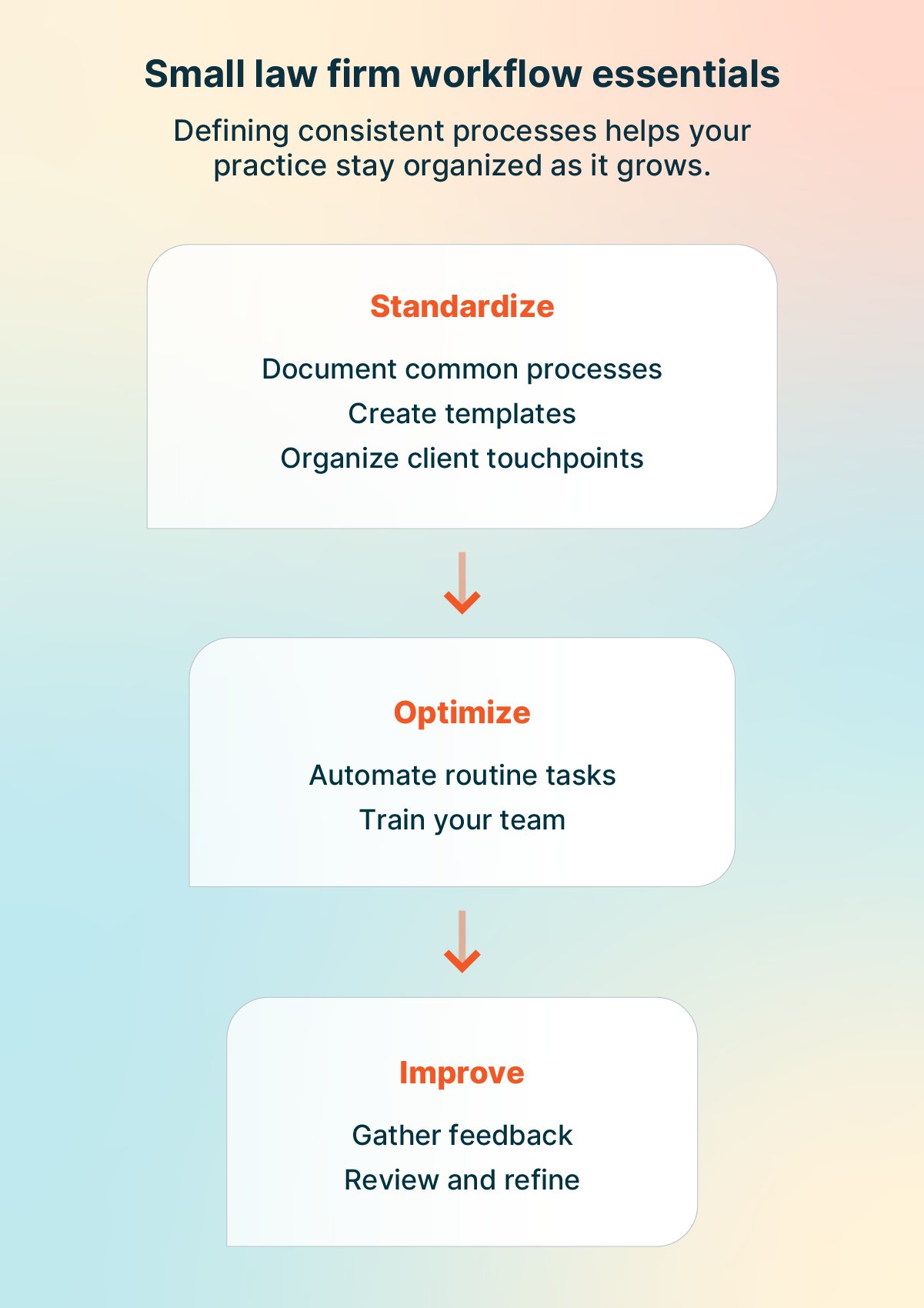
Establishing clear, repeatable workflows helps create a more consistent experience for both clients and employees. It also makes it easier to manage increasing workloads without adding unnecessary complexity.
Document standard workflows: Create written procedures for recurring tasks, and clearly identify who is responsible for each step so work moves smoothly from one team member to the next.
Use standardized templates: Create templates for common documents, emails, and client communications to improve consistency and reduce time spent drafting routine materials.
Build workflows around the client experience: Standardize key touchpoints—such as intake, status updates, and billing—so clients receive consistent communication regardless of who they're working with.
Automate routine processes: Legal practice management solutions can automate tasks such as client intake, appointment scheduling, document generation, billing, payment reminders, and task assignments, reducing administrative work and helping your team stay consistent.
Provide regular training: Review your firm's standard procedures with attorneys and staff regularly so everyone follows the same approach and understands any updates.
Collect feedback from your team: Ask the attorneys and staff who use your small law firm workflows where delays or frustrations occur. Small improvements suggested by your team can often have a meaningful impact on efficiency.
Review and refine your workflows: Revisit your procedures periodically to identify bottlenecks, eliminate unnecessary steps, and adapt to changes in your practice.
How to build a small law firm workflow
Document processes | Create templates | Automate tasks |
Client intake | Engagement letters | Appointment reminders |
Conflict checks | Intake forms | Invoice delivery |
Matter opening | Client correspondence | Payment reminders |
Document review | Fee agreements | Document requests |
Discovery | Settlement letters | Client follow-ups |
3. Investing in technology that supports growth
Technology plays an important role in helping small and solo law firms operate more efficiently. By reducing manual work and bringing key functions together in one place, legal practice management solutions can improve both productivity and profitability.
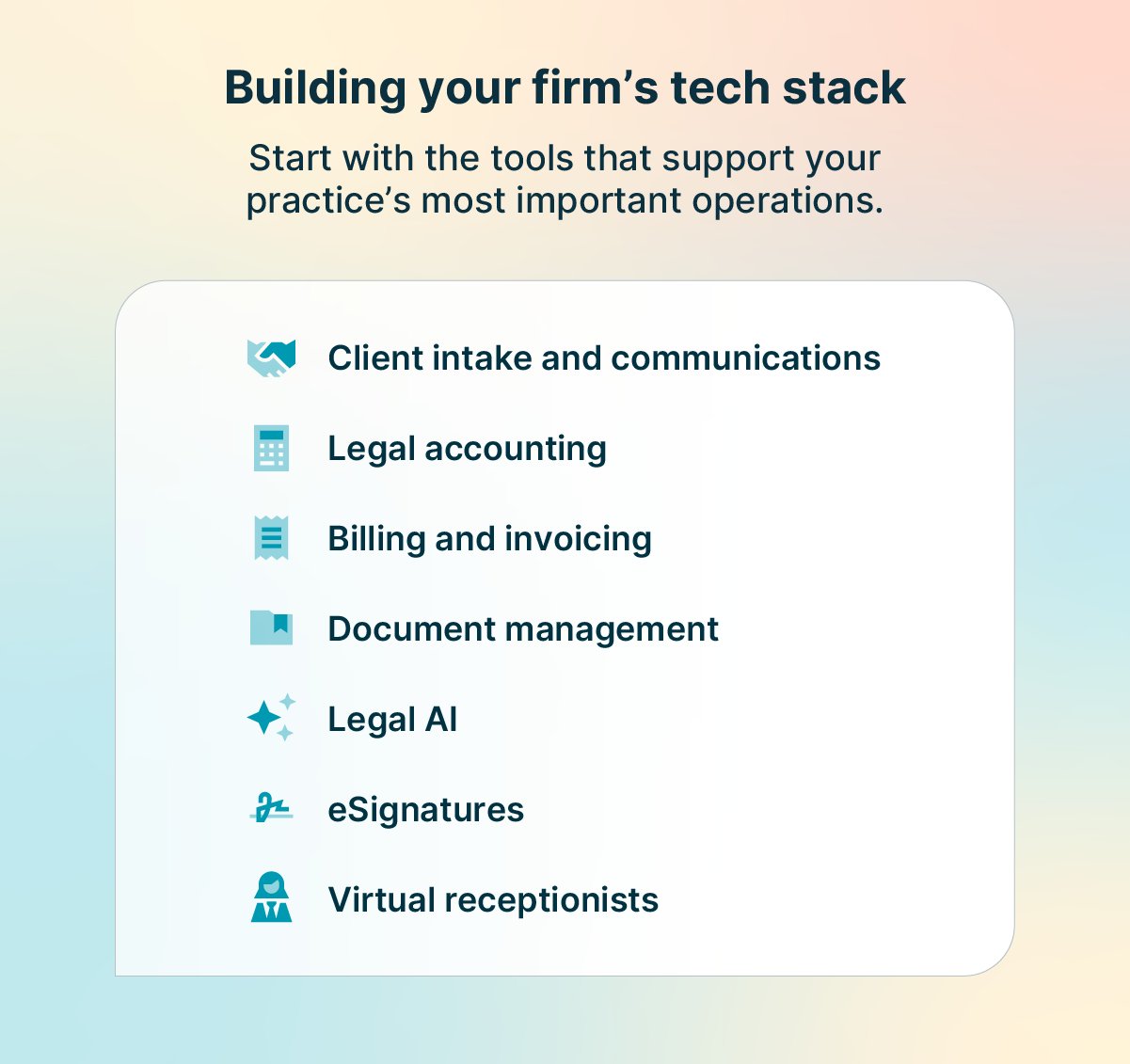
When comparing solutions, consider whether they include the following capabilities:
Client intake and communications: Online intake forms, lead tracking, appointment scheduling, secure messaging, and client portals can help reduce manual data entry, improve responsiveness, and create a more consistent onboarding experience for new clients.
Legal accounting: Accounting tools for small law firms can help manage trust accounting, reconcile transactions, and keep financial records organized while reducing duplicate data entry. Consider solutions that combine accounting with case management and billing so financial information stays connected.
Billing and invoicing: Legal-specific billing tools can simplify time tracking, automate invoice creation, send payment reminders, and accept online payments. Reducing manual billing tasks can help attorneys capture more billable time while making it easier for clients to pay promptly.
Document management and storage: Small law firm document management is easier when documents, emails, notes, and case files are stored in one centralized location. Tools that support document templates, version control, and automatic filing help keep information organized as your caseload grows.
Legal AI: Some legal practice management solutions now include built-in AI tools that allow legal teams to complete routine tasks more efficiently so they can spend more time on higher-value work. According to the 8am 2026 Legal Industry Report, 34% of surveyed law firms are now using legal AI tools—a significant increase from 21% in 2025. The most common uses for legal AI in 2026 include:
Legal research (58%)
Drafting documents (49%)
Summarizing documents (47%)
Drafting correspondence (43%)
General research (43%)
eSignatures: Built-in electronic signature tools help firms collect signed documents more quickly without requiring in-person meetings, printing, or mailing paperwork.
Virtual receptionists: Virtual receptionist services help ensure prospective clients can reach your firm even when your team is unavailable. They can also reduce interruptions during the workday while keeping call information organized and accessible.
4. Grow your client base
Small firms generally have limited marketing budgets, making it important to focus on cost-effective strategies that can continue attracting new clients over time. As you think about how to grow a small law firm, here are a few things to keep in mind:
Marketing: Build a professional website that clearly explains your services, practice areas, and experience. Creating helpful blog content, maintaining an active Google Business profile, and engaging with your local community can help prospective clients find your firm.
Referrals: Referrals remain one of the most valuable sources of new business for small firms. Network and stay connected with former clients, professional contacts, and other attorneys who may refer matters outside their practice areas.
Reputation management: Many prospective clients read reviews before choosing an attorney, and your firm’s online reputation can directly influence whether or not they decide to contact you. Knowing how to manage small law firm reviews means regularly monitoring ratings sites like Google, encouraging satisfied clients to leave feedback, and responding professionally to both positive and negative comments.
Manage your small law firm with the help of 8am MyCase
Running a small law firm typically involves managing casework, billing, client communication, document management, and dozens of other operational responsibilities, often with limited resources. MyCase helps bring those tasks together in one legal practice management solution, giving your firm the tools you need to work more efficiently as you grow.
MyCase includes tools for:
Practice and case management
Billing and payments
Time tracking
Automated invoicing
Document management
Calendaring
Client communications
Sign up for a free 10-day trial today and see why over 19,000 law firms—including thousands of solo and small practices—use MyCase to run more efficiently and build stronger businesses.
About the author

Rob Heidrick is a Senior Content Strategist for 8am, a leading professional business solution. He covers the latest advancements in legal technology, financial wellness for law firms, and key industry trends.