

Paralegals are adopting AI faster than their firms are preparing for it. According to survey data from 8am™ , 71% of paralegals use general-purpose AI tools like ChatGPT, Gemini, or Claude for work, slightly above the 69% of all legal professionals. Yet only 6% say their firm has a written, enforced AI policy, and just 17% have received any training.
This guide to AI for paralegals uses 8am survey data to answer the questions paralegals are actually asking: how colleagues use AI, whether it saves time, what holds people back, whether it threatens your job, and which skills to build. One note on the data: 87% of paralegal respondents work at firms with 1-5 lawyers, so the findings represent small firms, not Big Law.
Key takeaways
-
Most paralegals already use general-purpose AI, and far fewer use legal-specific tools.
-
More than half save at least an hour a week, and many more see better quality.
-
Security and trust, not cost, are the biggest brakes on adoption.
-
Policies and training lag well behind actual use, though paralegals are first in line for training.
-
Paralegals expect their tasks to change, and new AI-focused roles to emerge.
How much are paralegals using AI?
Most paralegals already use AI: 71% use general-purpose tools, and 38% use legal-specific tools, compared with 42% of all respondents.
Frequency is high, too. 29% of paralegals use generative AI every day, 33% several times a week, and 17% never use it. In other words, AI use is routine for roughly six in ten paralegals, not an experiment.
Firms are moving more slowly. 44% of paralegals say their firm has adopted general-purpose AI tools, and 32% say it has adopted legal-specific tools. What this means for you: many paralegals are using AI tools that their firm has not formally approved or set rules for, which makes safe-use habits your responsibility until policy catches up (more on that below). If you're comparing AI tools for paralegals, start with what your firm already pays for, since built-in tools are easier to approve.
What tasks are paralegals using AI for?
Primarily correspondence, research, drafting, and summarizing: the high-volume work that fills a paralegal's week.
Among the 161 surveyed paralegals who use general-purpose AI:
-
68% draft correspondence
-
55% conduct general research
-
52% draft documents
-
50% brainstorm
Among the 87 paralegals who use legal-specific tools, the mix leans toward more substantive work:
-
57% use them for legal research
-
54% for drafting documents and correspondence
-
52% for summarizing documents
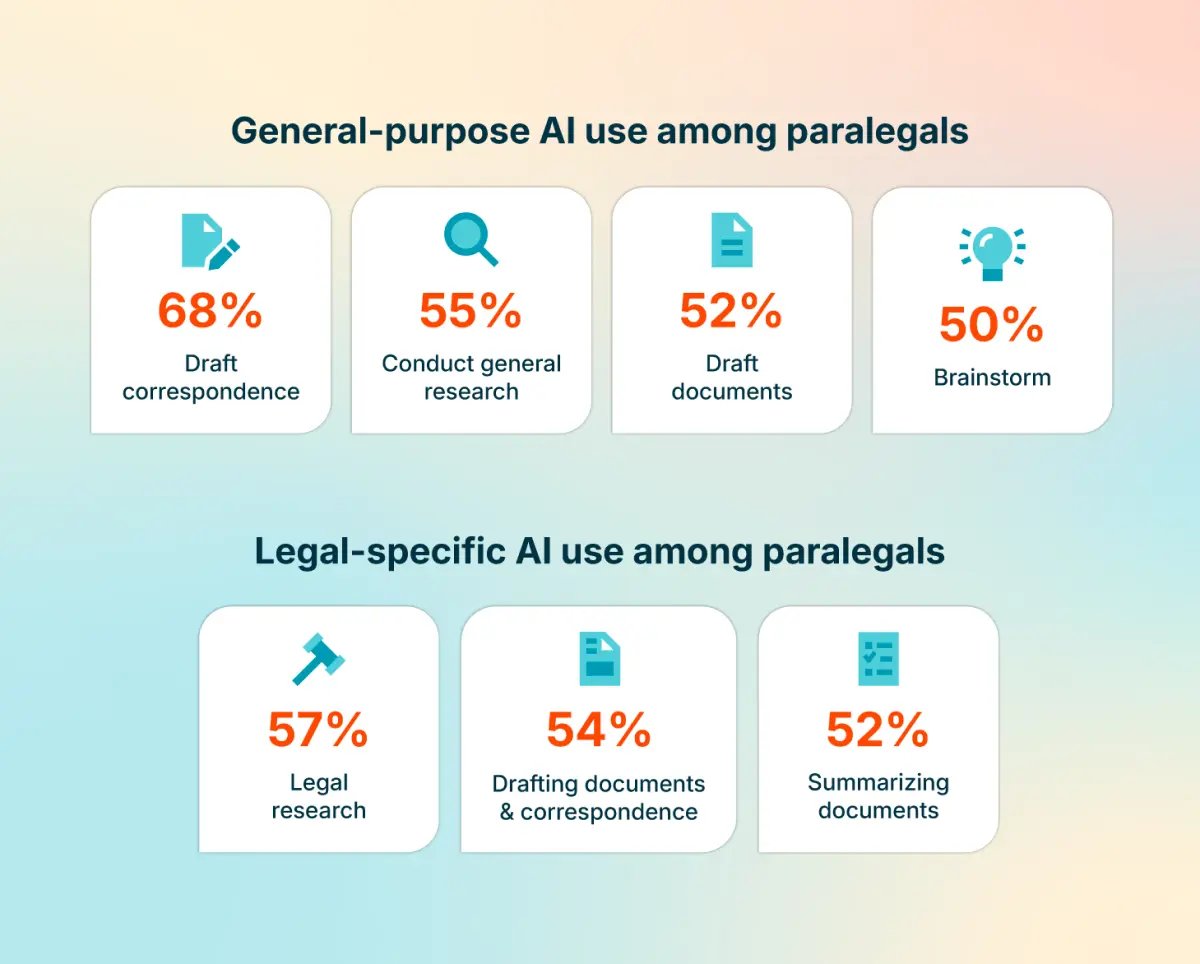
The pattern is useful for planning. General-purpose tools suit work that doesn't require applying legal principles, like rewording an awkward sentence. Anything involving client facts or legal analysis belongs in a tool your firm has vetted.
Practice-area snapshots
The samples below are small, so treat them as directional rather than definitive.
-
Personal injury (n=45): 49% of paralegals use AI for document summarization and analysis, and 89% believe AI could shorten litigation preparation. Medical records and demand packages are obvious candidates.
-
Immigration (n=38): 69% use AI for translation (37% frequently), and 61% use it for document drafting.
How is AI helping paralegals?
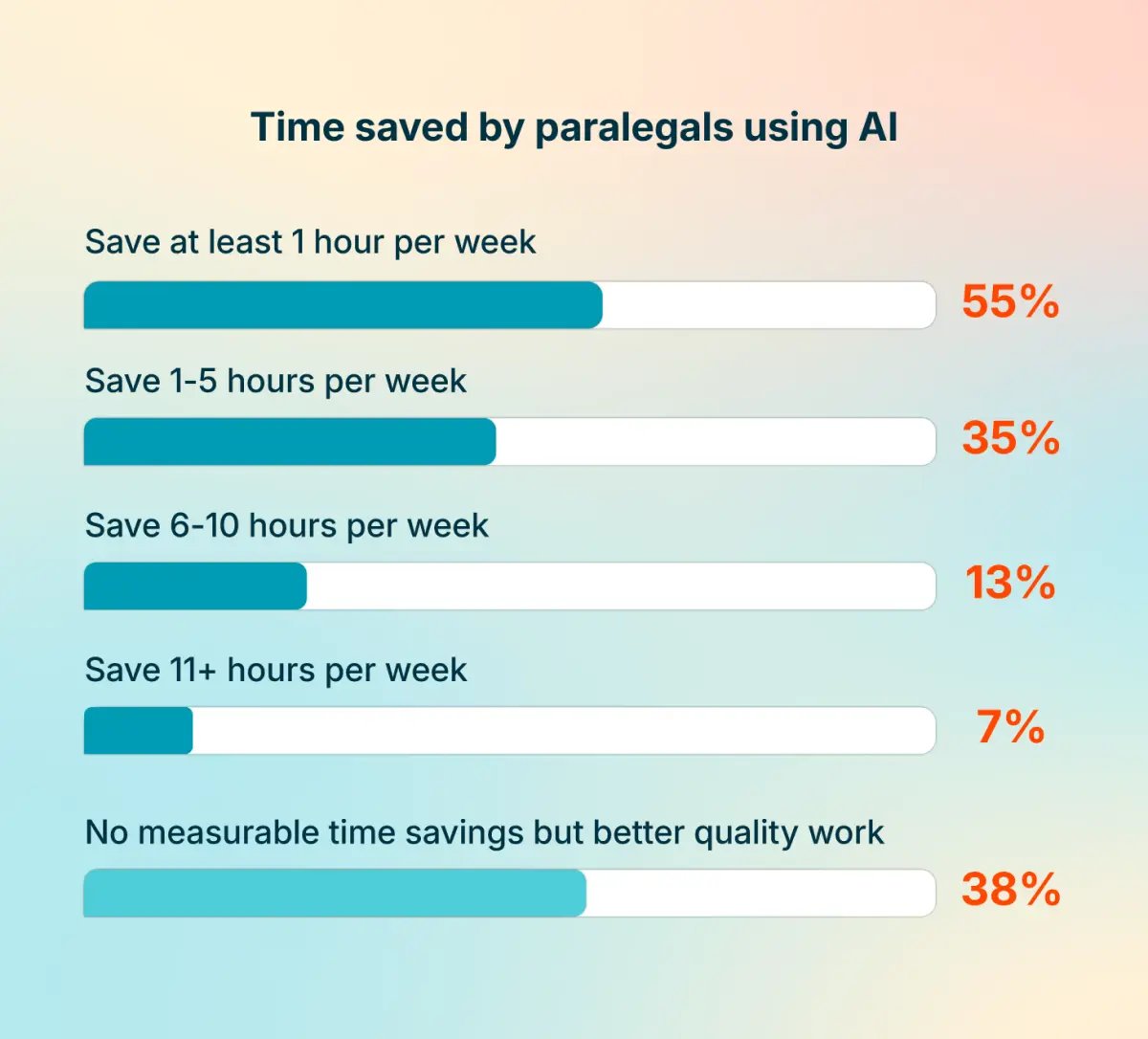
For most paralegals, it saves time, and for many, it improves the quality of their work even when the clock doesn't change. 55% of paralegals report saving at least one hour a week:
-
35% save one to five hours
-
13% save six to ten
-
7% save 11 or more
Another 38% report no measurable time savings but better quality work.
The biggest gains go to people who use AI the most. Among daily users, 38% save six or more hours a week, and 14% save 16 or more, the equivalent of two full workdays returned to casework, client communication, or trial prep.
What does this mean for you? Frequency drives results, so occasional use leaves hours on the table. Track the time you save on a few recurring tasks for a month. Concrete numbers make a strong case when you ask your supervising attorney for approved tools or training.
What's holding paralegals back from using AI?
Mostly concerns about security, trust, ethics, and privilege. When asked what slows AI adoption at their firms, paralegals cite data security (80% say significantly or moderately, 47% significantly), lack of trust in results (78%), ethical concerns (76%), and privilege concerns (73%).
Those worries shape which tools get approved. Among the 72 paralegals at firms using legal-specific AI, 54% say their firm chose it because it was released as part of software the firm already trusted. When you evaluate the best AI tools for paralegals, three criteria matter most: whether it is built into software your firm already vets, where client data goes, and whether it fits legal workflows.
Competitive pressure is low, too: 69% of paralegals report no or minimal pressure to adopt AI from competitors, and only 5% report strong pressure. That gives you room to adopt carefully.
Safe-use rules for paralegals
-
Never paste client names, facts, or documents into a public AI tool.
-
Use only the tools your firm has approved, and ask which ones those are.
-
Tell your supervising attorney when AI contributed to the work product.
-
Keep AI-assisted drafts out of filings until a person has reviewed them.
A five-step verification checklist
-
Check every case citation and statute in an official source.
-
Confirm quotes against the original document.
-
Compare names, dates, and amounts to the file.
-
Look for confident claims with no source and ask the tool to show its basis.
-
Note what you verified before the draft is sent to an attorney.
For the ethics side, our guide to AI in law and the criminal defense post on confidentiality and AI go deeper.
How many law firms have AI policies and training?
Very few, though paralegals are the group most likely to be trained first. Only 6% of paralegals report a written, enforced AI policy at their firm, and 44% say there is no policy and no plans to create one. Across all respondents, the picture is similar: 9% have an enforced written policy, and 43% have none planned.
Training is thin as well:
-
62% of paralegals say their firm has provided no AI training and has no plans to do so
-
Only 17% have received training (9% mandatory, 8% optional)
There is a bright spot: 49% of paralegals say they are being prioritized for AI training and resources, compared with 39% of all respondents. Because paralegals are reporting on their own role, read that number with some caution, but it suggests your firm may be receptive if you ask.
Confidence in readiness is mixed:
-
52% of paralegals feel their firm is very or somewhat prepared for AI-driven change over the next five years
-
18% feel unprepared
How to close the gap yourself
If your firm hasn't offered AI training for paralegals, you can start with a few steps:
-
Ask your supervising attorney which tools are approved and request a one-page usage policy.
-
Look for AI courses for paralegals through your state or national paralegal association and CLE providers.
-
Practice on non-confidential material, such as public documents or sample files.
-
Refer to this AI for law firm's resource hub to build a shared vocabulary with your attorneys.
Will AI replace paralegals?
AI is more likely to replace paralegals' tasks than paralegals themselves. When people ask whether paralegals will be replaced by AI , the data points to a changing role, not a disappearing one. Paralegals' own expectations are split: 34% expect AI to reduce paralegal and support roles over five years, 26% expect expansion, and 36% expect new AI-specialist or "legal technologist" roles. These options overlap, so don't read them as a ranking.
The bigger signal is a change in task. 59% of paralegals expect AI to significantly affect more than a quarter of routine legal tasks within five years, and 49% are optimistic about AI's long-term impact (16% are pessimistic).
What AI can't replace is the work that rests on judgment and trust: deciding what matters in a case file, noticing when a client is holding something back, and being accountable for what goes to an attorney or a court.
What skills should paralegals build for AI?
Start with AI fluency, then pair it with the human skills AI can't supply. Paralegals say the skills gaining value are technical fluency with AI tools (54%), client relationship management (50%), data analysis (50%), and data analysis (50%), and legal judgment and strategy (47%).
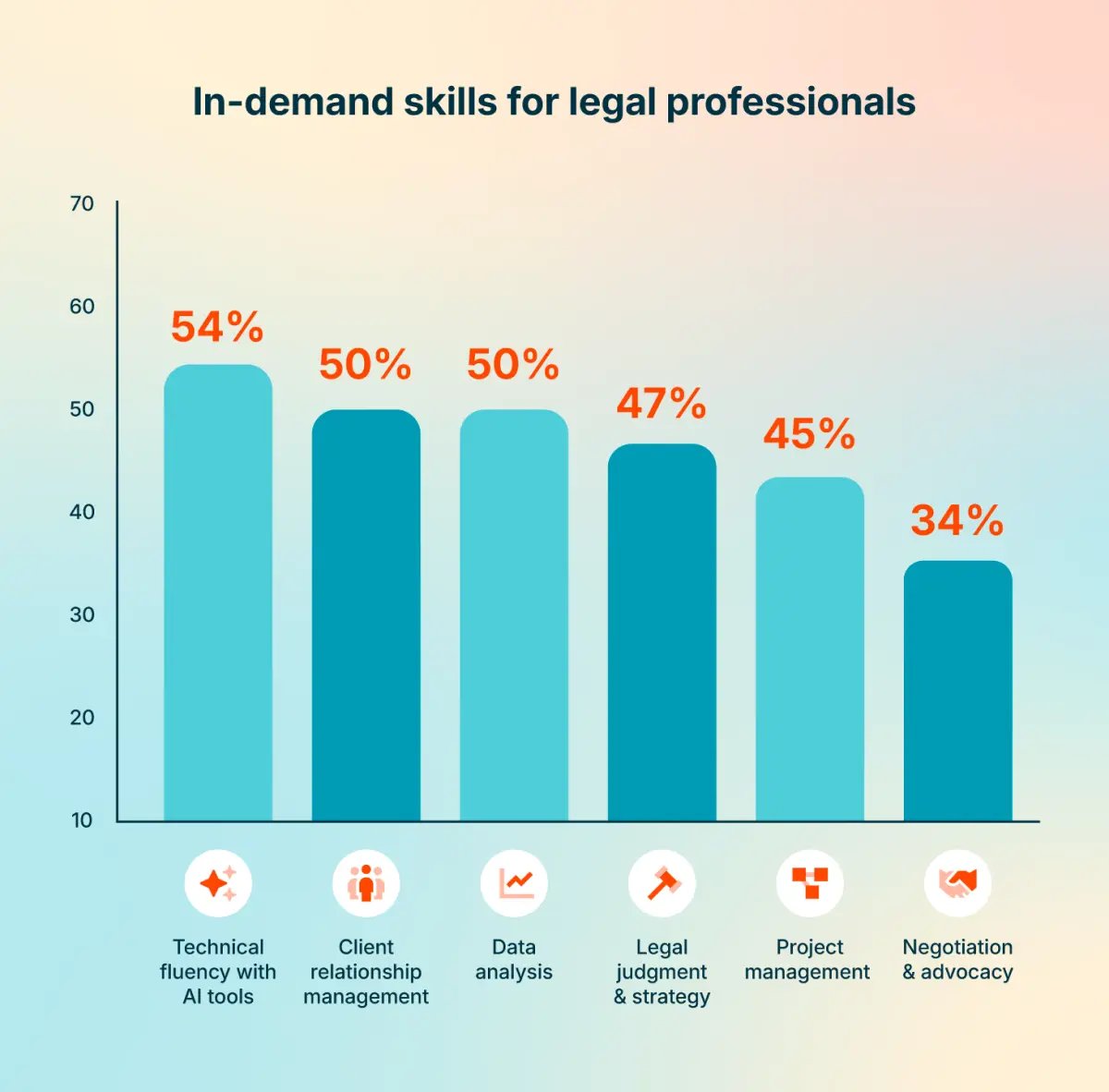
In practice, that means:
-
AI fluency: Learn to write clear prompts, give the tool context, and iterate on drafts.
-
Verification: Be the person who catches the wrong citation or the invented fact before it travels.
-
Data analysis: Get comfortable working with timelines, billing, and case data.
-
Client management and judgment: Use the time AI frees up for the conversations and decisions only a person can handle.
There is a career angle here, too. With 36% of paralegals expecting new AI-specialist roles, hands-on AI skill positions you to help your firm choose tools, write policy, and train colleagues. The survey doesn't measure pay, so we can't promise a raise, but it does show where the work is heading.
How 8am IQ for MyCase helps paralegals
8am IQ brings AI into the case management software paralegals already use, so you don't have to copy client information into a separate tool. That matters given the barriers above: 54% of paralegals at firms using legal-specific AI say their firm chose it because it was released inside software the firm already trusted.
8am IQ for MyCase includes four assistants that map to the tasks paralegals do most:
-
Writing Assistant : Drafts and refines correspondence and documents, the top paralegal use cases (68% draft correspondence and 52% draft documents with general-purpose AI).
-
Document Assistant : Summarizes and analyzes documents, which 52% of paralegals using legal-specific AI already do.
-
Case Assistant : Helps you get up to speed on a matter and find what you need in the file.
-
Discovery Assistant : Supports review and organization of discovery materials.
-
MyCase MCP : Lets you ask Claude questions about your cases, tasks, documents, and billing in plain language, with read-only access that follows your existing MyCase permissions (requires Claude Team or Enterprise).
8am IQ is included with MyCase Advanced and keeps client data within MyCase, which addresses the data security concerns 80% of paralegals report. It also gives you a safe place to build AI skills on real firm workflows.
You don't have to choose between moving fast with AI and keeping client data safe. See how 8am IQ helps your team summarize documents, draft correspondence, and review cases inside the software you already use— book a MyCase demo .
About the author

Mary Elizabeth Hammond is a Senior Content Strategist and Blog Specialist for 8am, a leading professional business solution. She covers emerging legal technology, financial wellness for law firms, the latest industry trends, and more.