

Key takeaways
Key takeaways:
-
39% of legal professionals lose at least four productive or billable hours each week to admin work
-
More than one-quarter estimate losing at least $10,000 in revenue each month due to admin burden.
-
Legal professionals want AI to handle practical busywork - primarily time tracking, billing, and invoicing - but 35% cite a lack of trust in AI, and 25% point to privacy or confidentiality concerns.
-
Administrative burden is not only an efficiency issue; it also delays client work, reduces time for strategy and service, and limits firms’ capacity to grow.
Administrative work has always been, and will be, part of running a law firm. But our latest research suggests that this tedious overhead is becoming a material business challenge.
As part of the 2026 8am™ Admin Misery Index , which explores how administrative work is impacting employees and businesses, we surveyed 400 professionals working across the legal sector. What we found is an industry navigating heavy administrative burden, resulting in lost billable hours, delayed client work, and missed time that could be spent on strategy and growth. Professionals are also looking to AI for relief, but not without reservations about trust, privacy, and confidentiality.
How much billable time is admin work costing legal teams?
Our research found that 40% of respondents estimate losing at least four productive or billable hours each week to administrative work. Where billable hours are closely connected to revenue, client service, capacity, and growth, at the firm level, this impact adds up quickly:
-
41% estimate that administrative burden costs their firm at least $5,000 in revenue each month; 26% say it’s at least $10,000
-
78% say admin work limits their ability to take on new clients or grow their practice to some extent
-
92% say admin work interferes with their core responsibilities to some extent; two-thirds say this happens at least sometimes
-
35% have delayed client or customer work because of administrative drag
These findings show why administrative burden can become a hidden tax on professional work. Time entry, billing, scheduling, payment collection, and information management are essential to running a healthy law firm. The challenge is that without proper tooling and workflows, it’s inefficient, disconnected, and predominantly manual. When firms streamline these operations, professionals can spend less time managing administrative tasks and more time on the success of their firm.
What is causing legal admin stress?
A third of legal professionals say administrative work makes them moderately to extremely miserable, and another 42% say it gives them a moderate to extreme feeling of dread every Sunday before the workweek begins, commonly known as the Sunday Scaries. But what exactly is causing this strain?
The administrative tasks creating the most pressure span the entire client and financial lifecycle. According to our research, stress or anxiety stem most often from time tracking (44%), client communications (41%), scheduling and calendar management (38%), billing and invoicing (37%), and payment collection or invoice-chasing (36%).
Many of these tasks are interconnected. Time tracking failures delay billing, delayed billing stalls collection, stalled collection generates more client back-and-forth. You can see how this domino effect quickly consumes hours and resources, while also leading to process gaps and overlooked closures.
What’s worse, when each part of that workflow lives in a different system, the administrative burden grows exponentially as professionals re-enter information, verify records, and manually transfer data between applications. The result is a perpetual game of admin whack-a-mole: By the time one task is completed, another one (or several) has popped up, delaying professionals from delivering higher-value work.
Admin work and the AI opportunity
AI is already becoming part of legal professionals’ day-to-day. According to 8am’s 2026 Legal Industry Report , nearly 70% of legal professionals use general-purpose AI for work, while 42% use legal-specific AI. Among those using AI, 94% report measurable benefits in time savings or work quality. Research, document drafting, summarization, and correspondence are among the most common legal-specific applications.
The Admin Misery Index examines another important opportunity: using AI to streamline operational work. Because time tracking is legal professionals’ leading source of administrative stress, it’s unsurprising it emerged as the administrative task they most want AI to help reduce or eliminate (42%).
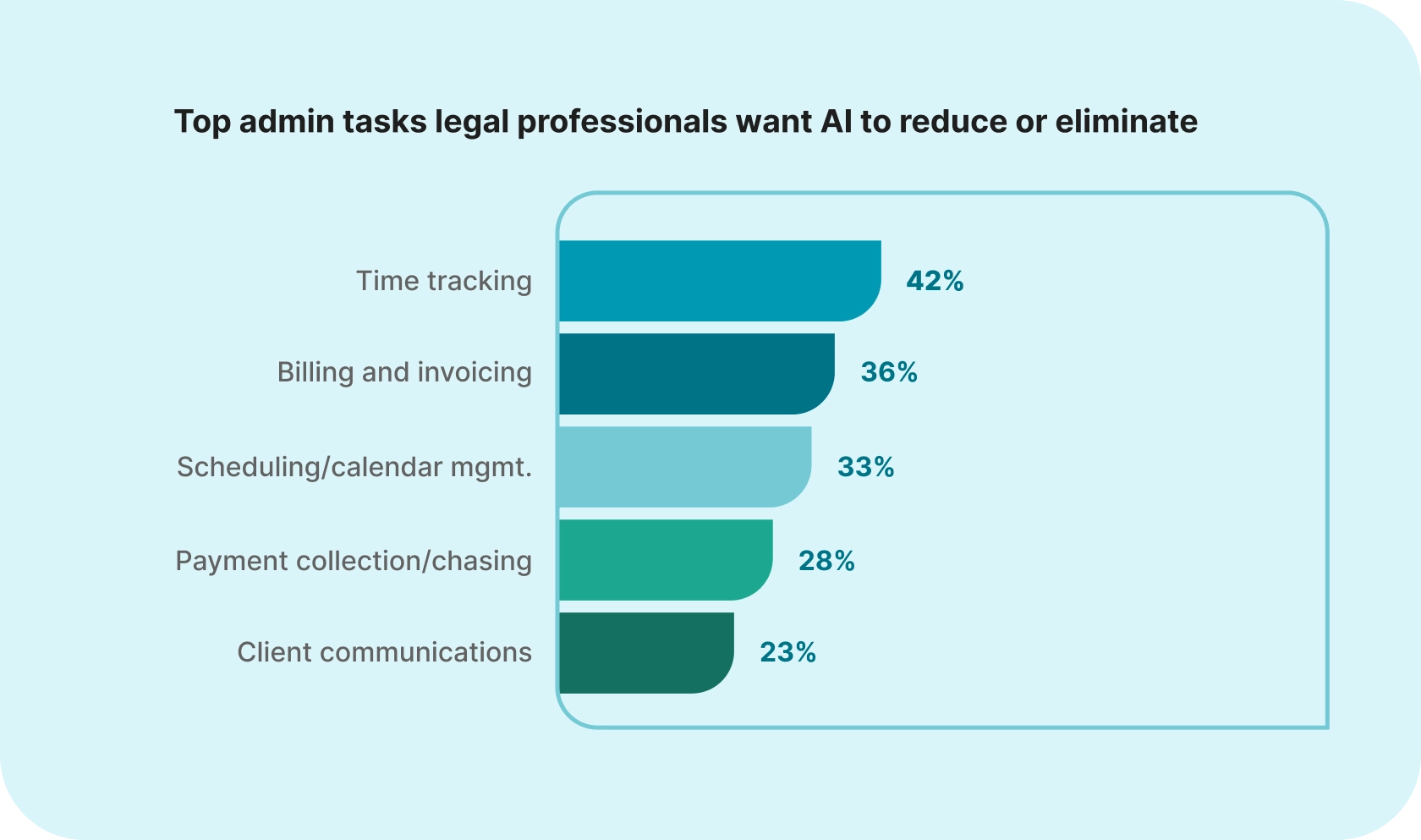
For legal teams, AI’s most practical value may be on the business side of law. Tasks such as capturing time, preparing bills, scheduling follow-ups, collecting payments, and drafting routine communications are critical to a successful firm, but are primed for streamlining. Applying AI and automation to these repeatable workflows can make administrative work faster and more consistent, while giving teams time back for billable legal matters.
However, while the potential benefits of using legal AI for administrative tasks are clear, legal professionals remain cautious with the technology. Thirty-five percent cite a lack of trust in AI as a barrier to adopting AI tools, while 25% point to privacy or confidentiality concerns. To overcome this, AI providers must go beyond mere automation and demonstrate that sensitive information is protected, outputs can be reviewed, and professionals remain in control.
How law firms can reduce administrative drag
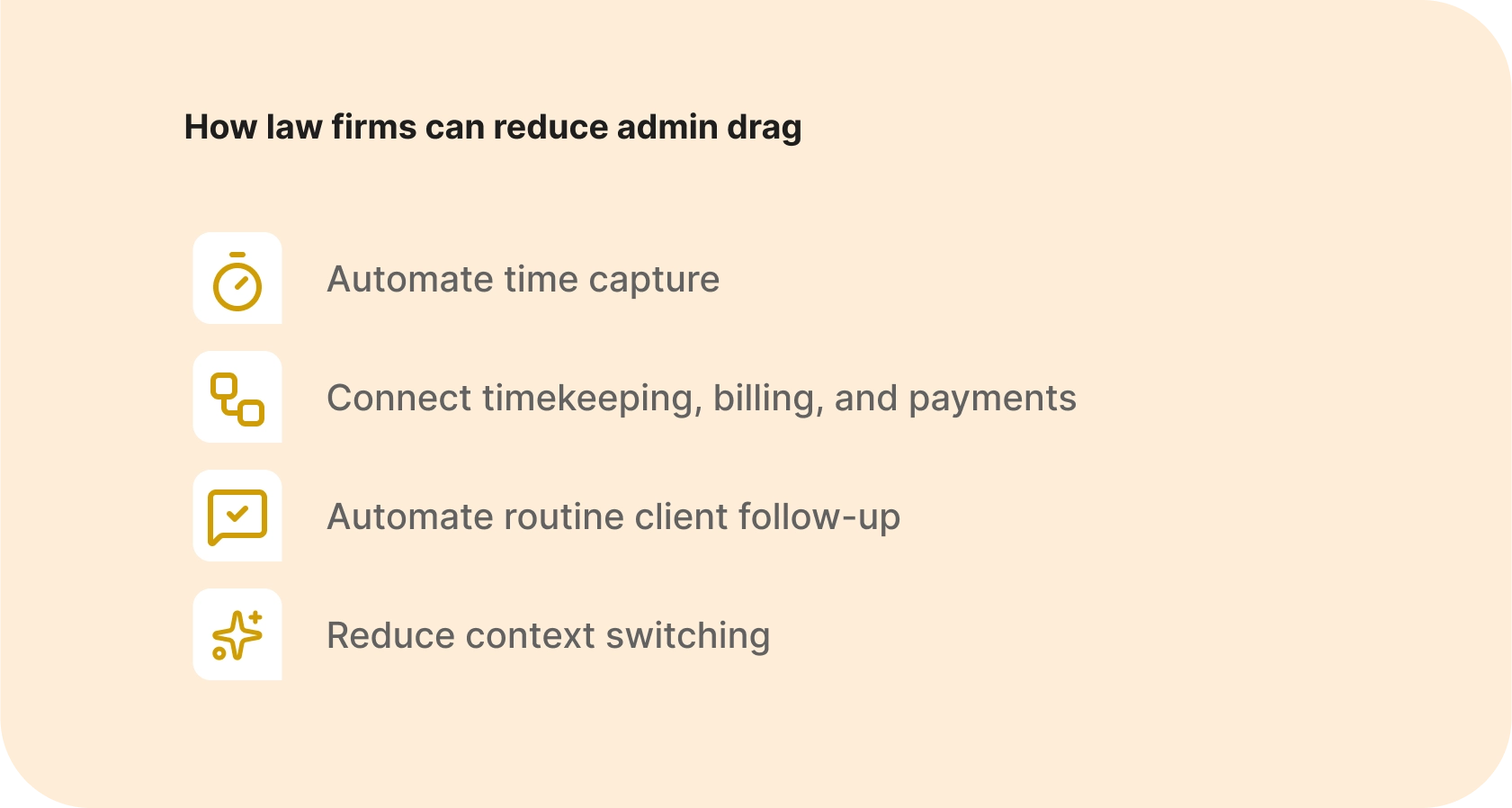
Technology alone will not solve every administrative problem. Firms also need to examine how work moves, where duplication occurs, and which tasks require professional judgment versus repeatable execution. Here are four ways law firms can make administrative work more efficient:
-
Automate time capture: Delayed or reconstructed time entry increases the risk that billable work will be forgotten. Firms should look for ways to automatically capture activity within the systems where billable work occurs, rather than relying on professionals to recreate it later. The result is improved accuracy and detail, faster invoicing, and reduced anxiety.
-
Connect timekeeping, billing, and payments: Connecting these workflows can reduce duplicate entries, shorten the path from completed work to revenue, and make it easier to monitor outstanding balances. It also provides an opportunity for deeper performance analysis and greater overall financial transparency. This can extend to collections as well, where integrated tools such as CollBox can manage past-due invoice follow-up directly from a firm’s case management system.
-
Automate routine client follow-up: Repeatable messages like scheduling confirmations and payment reminders can create significant communication volume. Thoughtful AI automation can reduce manual work while keeping professionals in control of tone, timing, and sensitive communications.
-
Reduce context switching: Firms should assess whether core workflows can be managed within fewer connected experiences, particularly across matters, calendars, time-keeping, billing, and payments. Built-in AI tools and agentic agents can significantly reduce context switching by embedding relevant capabilities within existing applications and workflows or pulling necessary data for the user from other systems.
-
To support modern law firms, 8am brings together practice management, payments, and AI through solutions including MyCase , LawPay , CasePeer , DocketWise , and 8am IQ . Firms can reduce repetitive work across connected workflows designed for the business of law.
More data from 8am’s Admin Misery Index can be found here and here . Additionally, visit the 8am MyCase AI Resource Center to learn more about the future of law and AI.
Study Methodology:
The 8am 2026 Admin Misery Index is based on two surveys fielded in June 2026: a survey of 1,200 U.S. professionals across corporate, desk-based, and professional services environments, and a companion survey of 400 U.S. legal professionals, including attorneys, paralegals, legal operations professionals, in-house counsel, and law-firm business and administrative roles (1,600 respondents total). All respondents had at least some level of administrative responsibility.
